Submissions

Login or Register to make a submission.

Author Guidelines

EKJ using Vancouver (superscripts, brackets, only year in date) style of writing citations and bibliography. Instructions for writing citations and bibliography please visit the following link: Vancouver (superscripts, brackets, only year in date) and Vancouver (superscripts, brackets, only year in date) reference generator. But for your convenience, we strongly suggest to use Mendeley software to help you referencing and citing works.

Aside from bibliography style that we stated above, we also need to remind you, that you need to fulfill following items on your submission: 1) Using at least 15 references; 2) related with our focus and scope; and 3) Result from plagiarism checker (Turnitin) is less than or equal to 25 percent (which means, if the result is more than 26 percent, your submission will be rejected automatically).

Manuscript Assessment Process
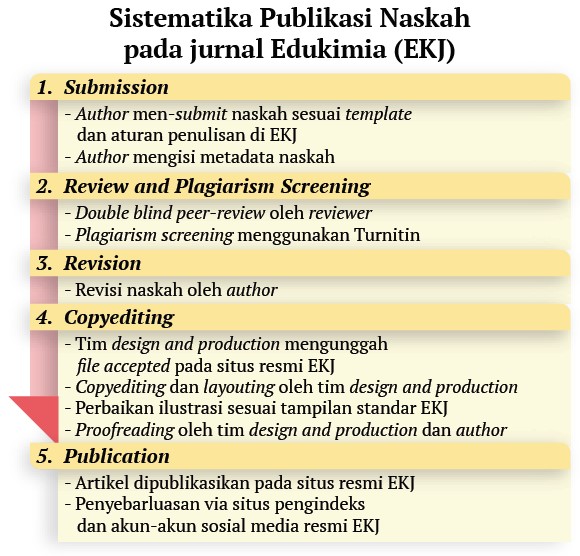
Any accepted manuscript will be reviewed by at least two reviewers, plus editorial comments. The author is required to revise the manuscript according to reviewer comments and editors. Editor team will process it for later publication. For peer review process diagrams please go to Peer Review Process page.

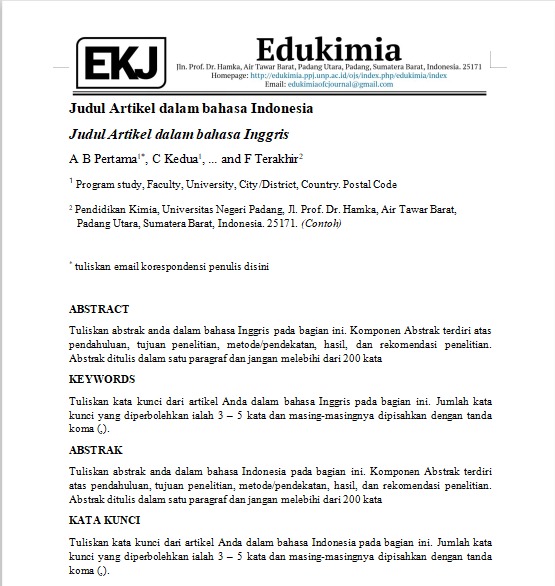
Please use our template to help you format your manuscript in the EKJ, please go to the Manuscript Template page. We have created temporary guidelines to help author understand submission process into Edukimia journal website.

For submission process, please refer into this page for more information.

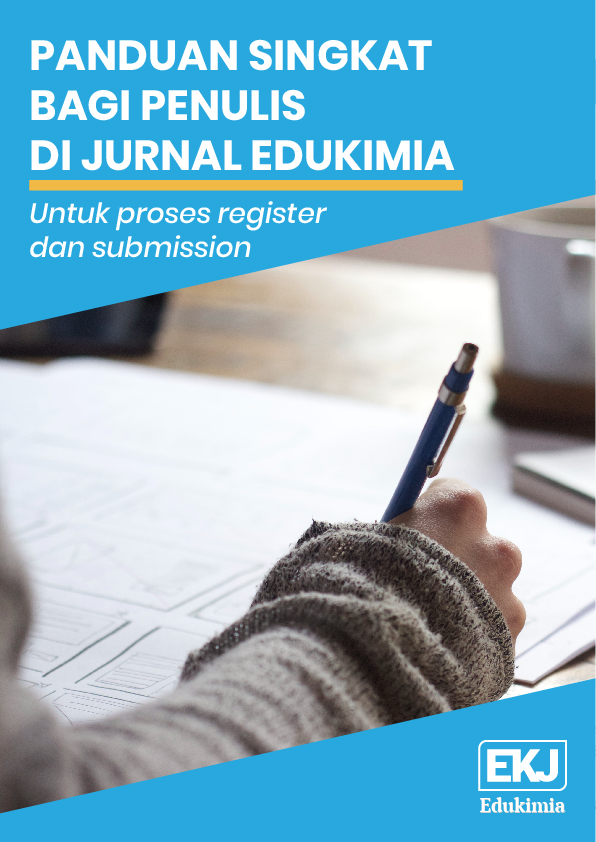
For manuscript writing guide, please refer to this Edukimia Quick Guide: How to Write Manuscript for Edukimia Journal.

Also to ease the submission process, we have decided to divide our <a href="/ojs/index.php/edukimia/about/editorialPoli

Curriculum, Learning or Teaching Models, and Article Review

which include:
    • Global Issues in Education and Research
    • Educating the educators
    • Curriculum
    • Lesson Study
    • Chemical Literacy

Assessment and Learning Evaluation

 which include:
    • Learning or Teaching Methodologies and Assessment
    • Teacher Evaluation

Media and Technology in Education

which include:
    • Ethnopedagogy-based STEM Education
    • Collaborative and Interactive Learning
    • Tools for 21st Century learning
    • Pedagogy Enhancement with E-Learning
    • Web-based tools for education
    • Games and simulations in Education
    • Professional Development for teachers in ICT
    • Technology Support for Pervasive Learning
    • Interaction in Education
    • Mobile or ubiquitous computing in education

Privacy Statement

The names and email addresses entered in this journal site will be used exclusively for the stated purposes of this journal and will not be made available for any other purpose or to any other party.