Peer Review Process
1. Peer Review Policy
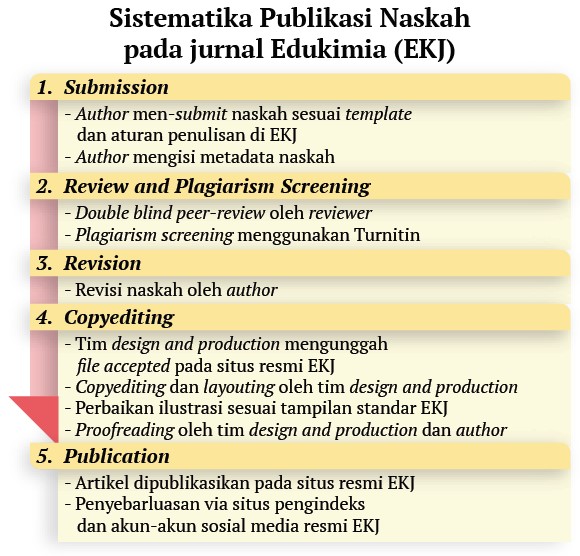
Edukimia applies a double-blind peer-review system to ensure the scientific quality, originality, relevance, and integrity of manuscripts submitted for publication. All manuscripts undergo administrative screening and preliminary editorial assessment before being considered for external peer review.
Manuscripts that pass the preliminary evaluation are reviewed by at least two independent reviewers with expertise relevant to the subject of the manuscript. Under the double-blind system, the identities of authors and reviewers are concealed from each other throughout the review process.
The peer-review process follows the journal's publication ethics policy and relevant guidance from the Committee on Publication Ethics (COPE).
2. Manuscript Submission and Administrative Screening
Authors must submit their manuscripts through the Edukimia online journal management system.
The Editorial Admin conducts an initial administrative screening to verify compliance with the journal's submission requirements, including:
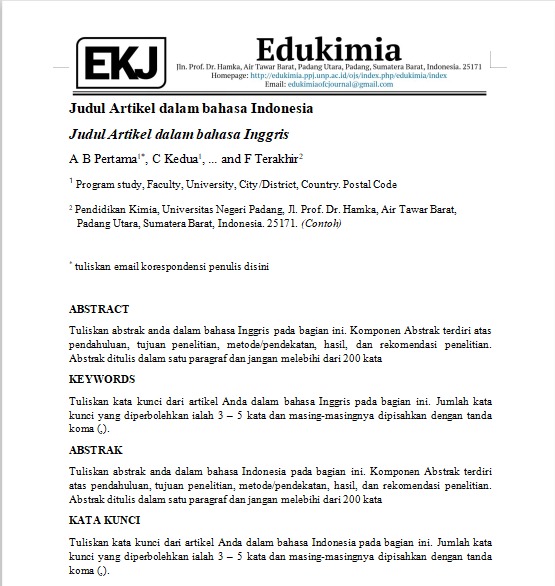
- Compliance with the manuscript template and Author Guidelines.
- Manuscript structure and word count.
- Completeness, adequacy, and formatting of references.
- Citation style and manuscript formatting.
- Completeness of required submission documents.
- Textual similarity screening using Turnitin.
Manuscripts that do not meet the administrative requirements may be returned to the authors for correction before further editorial evaluation.
3. Preliminary Editorial Assessment
After administrative screening, the Editor-in-Chief examines the manuscript and assigns it to a Section Editor for preliminary scientific assessment.
The Section Editor evaluates the manuscript's relevance to the journal's aims and scope, clarity of research objectives, appropriateness of methodology, scientific merit, and potential contribution to chemistry education.
Based on this assessment, the manuscript may be rejected, returned to the authors for preliminary revision, or approved for external peer review.
Manuscripts requiring preliminary revision must be resubmitted and reassessed before reviewer assignment.
4. Reviewer Selection and Qualifications
Manuscripts approved for external peer review are assigned to at least two independent reviewers.
Reviewers are selected based on the following qualifications:
- Expertise relevant to the manuscript's subject area.
- A relevant scientific publication record, preferably within the previous three years.
- Research experience and competence in evaluating scientific methodologies.
- Ability to provide objective, critical, substantive, and constructive evaluations.
- Independence from the authors and absence of conflicts of interest.
- Commitment to confidentiality, publication ethics, and the journal's review timeline.
The editorial team considers reviewers' scientific expertise, publication records, institutional affiliations, and previous review performance when making assignments.
5. Manuscript Review Criteria
Reviewers evaluate manuscripts using the Edukimia Reviewer Evaluation Form, which covers the following scientific components:
Title
The relevance, clarity, and consistency of the manuscript title with the research content.
Abstract
The clarity and completeness of the abstract, including research objectives, methodology, principal findings, interpretation, implications, and academic writing quality.
Research Background
The clarity and significance of the research problem or phenomenon presented in the background.
State of the Art, Research Gap, and Research Objectives
The adequacy of the literature review, identification of research gaps, justification of originality and novelty, and clarity of research objectives.
Research Methodology
The appropriateness of the research design, methods, instruments, procedures, and data analysis techniques in addressing the research objectives.
Research Results
The relevance, adequacy, and consistency of the research findings and data in addressing the research questions or objectives.
Data Interpretation and Discussion
The depth and accuracy of data interpretation, the scientific reasoning supporting the findings, and the critical comparison of results with relevant previous studies.
Conclusions and Implications
The consistency of the conclusions with the research objectives and findings, including the appropriateness of implications or recommendations.
References
The relevance, adequacy, currency, and consistency of references and their compliance with the journal's citation guidelines.
Research and Publication Ethics
Compliance with applicable research ethics requirements, including ethical approval, informed consent, research integrity, and appropriate reporting where relevant.
Reviewers are expected to provide substantive comments and constructive recommendations through the journal's review form.
6. Review Timeline
Reviewers are expected to complete their evaluations within 14–21 calendar days after accepting the review invitation.
If additional time is required, reviewers must inform the editorial team. The editor may grant an extension or assign another qualified reviewer when necessary.
The actual duration of the review process may vary depending on manuscript complexity, reviewer availability, and revision requirements.
7. Similarity Screening
Edukimia uses Turnitin to screen submitted manuscripts for textual similarity during the initial administrative evaluation. Additional similarity screening may be conducted following manuscript revision.
Similarity reports are evaluated by the editorial team to identify potentially inappropriate textual overlap, plagiarism, or citation-related concerns. The evaluation considers the nature, context, and extent of textual similarities rather than relying solely on the overall similarity percentage.
Manuscripts containing suspected plagiarism or other publication ethics violations may be returned for clarification, rejected, or subjected to further investigation.
8. Editorial Decision
After the reviewers submit their evaluations, the Section Editor examines the review reports and assesses the manuscript's scientific quality and compliance with the journal's requirements.
Reviewers provide scientific assessments and recommendations; they do not make the final publication decision.
The editorial decision may include:
- Accept: The manuscript meets the journal's scientific and editorial requirements.
- Minor Revision: The manuscript requires limited corrections or clarifications.
- Major Revision: The manuscript requires substantial improvements to its scientific content, methodology, analysis, interpretation, or presentation.
- Reject: The manuscript does not meet the journal's scientific or editorial standards.
The final decision is made by the Editor-in-Chief or an authorized editor based on the reviewers' assessments, the manuscript's scientific merit, and the authors' responses.
9. Author Revision and Editorial Reassessment
Authors receiving revision requests must revise their manuscripts and submit a point-by-point response addressing the reviewers' and editors' comments.
Authors may provide scientifically justified explanations when specific reviewer requests cannot reasonably be fulfilled.
The Section Editor evaluates the revised manuscript and the authors' responses to determine whether the identified concerns have been adequately addressed.
Manuscripts requiring substantial additional revisions may be returned to the authors or reassigned for further peer review when necessary.
A manuscript is accepted only after the editorial team determines that it satisfies the journal's scientific and editorial standards.
10. Publication Ethics and Reviewer Responsibilities
Edukimia is committed to maintaining an ethical, fair, independent, confidential, and transparent peer-review process in accordance with relevant guidance from the Committee on Publication Ethics (COPE).
Reviewers are required to maintain the confidentiality of manuscripts, provide objective and constructive evaluations, disclose potential conflicts of interest, conduct reviews within their areas of expertise, and complete their evaluations within the agreed timeframe.
Reviewers must not use unpublished manuscript information for personal or professional advantage. Suspected research or publication misconduct must be reported confidentially to the editorial team.
Editorial decisions must be based on scientific merit, research integrity, and compliance with the journal's policies, without inappropriate influence from financial or other nonacademic considerations.
Use of Artificial Intelligence in Peer Review
Edukimia prohibits peer reviewers from using artificial intelligence (AI) tools to analyze or evaluate submitted manuscripts, generate or revise peer-review comments, or formulate review recommendations. Reviewers must not upload or enter manuscripts, manuscript excerpts, unpublished research data, or confidential review materials into AI applications. Authors and editors must comply with the journal's Artificial Intelligence (AI) Policy, including the applicable disclosure requirements. AI must not replace independent scientific judgment or editorial decision-making. Further information is available in the journal's Artificial Intelligence (AI) Policy.
11. Copyediting, Proofreading, and Publication
Manuscripts that receive final acceptance proceed to copyediting, proofreading, and publication preparation.
The editorial team checks language quality, consistency of scientific terminology, citation formatting, and manuscript layout.
Authors may be requested to review the final proof before publication.
Any applicable publication fees are administered in accordance with the journal's publicly available fee policy and do not influence editorial decisions.
Accepted manuscripts are published on the official Edukimia website and disseminated through the journal's established indexing and publication channels.