Author Guidelines
1. General Information and Manuscript Requirements
Edukimia is a scientific journal that publishes original research articles and review articles in chemistry education. The journal provides a platform for researchers, lecturers, teachers, and education practitioners to share research findings and scholarly contributions that support the development and improvement of chemistry education.
Edukimia welcomes manuscripts related to the following areas:
- Curriculum, Learning or Teaching Models, and Article Review
- Assessment and Learning Evaluation
- Media and Technology in Education
Submitted manuscripts must be original, relevant to the journal's focus and scope, and make a meaningful contribution to chemistry education. Manuscripts must not have been previously published or be under consideration for publication in another journal.
Authors must ensure that their manuscripts meet the following requirements:
- The manuscript is relevant to the journal's focus and scope.
- The manuscript presents a clear research objective, appropriate methods or review approach, and well-supported findings or conclusions.
- The manuscript is written in Indonesian or English using clear, accurate, and consistent academic language.
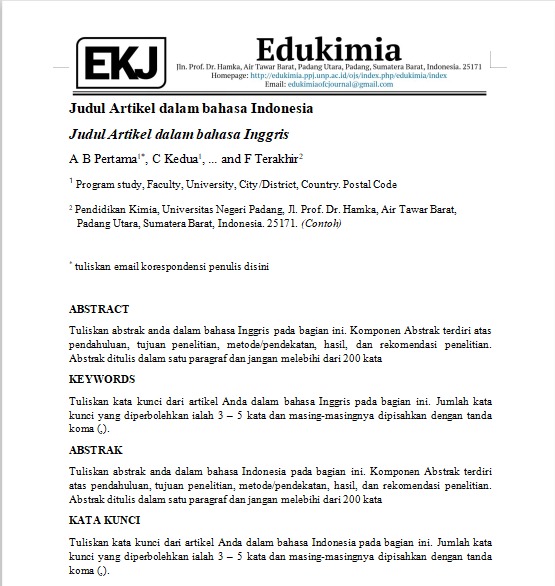
- The manuscript follows the official Edukimia template and the instructions provided in these guidelines (the Indonesian Manuscript Template or the English Manuscript Template).
- All sources are properly acknowledged and cited.
- The manuscript complies with the journal's publication ethics and academic integrity policies.
Authors are required to use the official Edukimia manuscript template.
2. Types of Manuscripts
Edukimia accepts two types of manuscripts: Original Research Articles and Review Articles.
Original Research Articles
Original Research Articles report findings from original studies in chemistry education. These articles must present a clearly defined research problem, appropriate research methods, reliable findings, and a discussion of their contributions to chemistry education.
Research topics may include curriculum development, teaching and learning models, chemistry learning assessment, educational technology, learning media, and other areas relevant to the journal's focus and scope.
Review Articles
Review Articles critically examine and synthesize published research on topics relevant to chemistry education. They should provide more than a summary of previous studies by identifying research trends, comparing findings, evaluating limitations, and discussing implications for future research.
Review Articles must have a clear objective, a defined scope, and a transparent approach to identifying, selecting, and analyzing relevant literature.
Both Original Research Articles and Review Articles manuscript length is 2500-6000 words, counted from the Introduction to the Conclusion.
3. Manuscript Structure and Content Guidelines
3.1 Title
The manuscript must include titles in Indonesian and English.
The Indonesian title must be concise, clear, informative, and contain no more than 15 words.
The title should accurately represent the main topic of the manuscript and avoid unnecessary abbreviations or general expressions.
3.2 Author Information
Author names and affiliations must follow the format provided in the official Edukimia template.
Author names should be presented using the name format illustrated in the template. Authors must provide their institutional affiliations, including study program or department, institution, city, province, country, and postal code.
The corresponding author must be identified with an asterisk (*) and provide an active email address.
All authors must agree on the authorship and author order before submission.
3.3 Abstract
Manuscripts must include abstracts in Indonesian and English.
Each abstract must be written in a single paragraph and contain no more than 200 words.
The abstract should briefly present the research background, objective, methods or approach, main findings, and conclusions or recommendations.
The research objective must be stated clearly and explicitly.
The abstract should accurately represent the entire manuscript and allow readers to understand its main contribution without reading the full article.
For Review Articles, the abstract should summarize the review objective, literature selection or analysis approach, major findings, and conclusions.
3.4 Keywords
Authors must provide 3–5 keywords in Indonesian and English.
Keywords must accurately represent the main concepts discussed in the manuscript and be separated by commas.
Authors should select specific and relevant keywords to improve article discoverability and indexing.
3.5 Introduction
The Introduction must present the research background, state of the art, research gap, and research objective in a clear and systematic manner.
The general research background should be concise and should not exceed two paragraphs.
The state of the art must be supported by at least 10 relevant research articles published within the last 10 years.
Authors must critically discuss previous research to explain the current development of knowledge in the field.
The research gap must be clearly and explicitly identified to demonstrate the novelty and distinctive contribution of the present study.
The Introduction must conclude with a clear research objective that is consistent with the identified research gap.
For Review Articles, the Introduction should explain the importance of the review topic, its scope, the limitations of existing knowledge, and the specific objectives or questions addressed.
3.6 Methods
The Methods section must provide a clear and sufficiently detailed explanation of how the research was conducted.
For Original Research Articles, this section must describe, where applicable:
- Research design and approach.
- Research participants, subjects, or objects.
- Research location or setting.
- Research instruments and materials.
- Data collection procedures.
- Instrument validity and reliability.
- Data analysis techniques.
- Statistical methods and tests used.
The research procedures must be presented systematically and in sufficient detail to allow readers to understand and, where appropriate, replicate the study.
Authors must not omit important steps in the research procedures.
When statistical analysis is performed, the methods used to process and analyze the data, including the types of statistical tests, must be clearly explained.
For Review Articles, the Literature Review Method must describe the literature search and selection procedures, information sources, inclusion and exclusion criteria where applicable, and the approach used to analyze and synthesize the selected studies.
3.7 Results and Discussion
The Results and Discussion section must present the main findings and explain their scientific and educational significance.
Authors should present processed and analyzed data rather than extensive raw data.
Results may be presented using tables, graphs, and figures when they improve clarity and understanding.
According to the official Research Article template, a maximum of five tables and figures combined may be included in the Results and Discussion section.
The findings must be relevant to the research objectives or questions and supported by appropriate analysis.
The Discussion must interpret the findings rather than simply repeat the results.
Authors should:
- Explain the meaning and significance of the main findings.
- Relate the findings to the research objectives.
- Compare the findings with relevant theories and previous studies.
- Discuss findings that support or differ from earlier research.
- Explain unexpected results where appropriate.
- Describe the implications for chemistry education.
- Acknowledge relevant research limitations.
Interpretations must be supported by research findings and appropriate scientific references.
For Review Articles, the Results and Discussion section should critically synthesize the selected literature, identify research trends and inconsistencies, and discuss the implications for research and educational practice.
Tables, Figures, and Equations
Tables, figures, and equations must be clear, informative, and directly relevant to the manuscript.
All tables and figures must be numbered consecutively according to their first appearance and referred to in the text.
Tables must be numbered consecutively, such as Table 1, Table 2, and Table 3.
Each table must have a clear and concise title placed above the table and centered.
Tables must follow the formatting style provided in the official Edukimia template.
Tables should not have outer borders. Internal lines should be used sparingly, and lines separating table content should be thinner than the main lines separating headings and data.
Each table must be referred to in the manuscript using its number.
For example:
"The results of the validity assessment are presented in Table 1."
Table 1. Title of Table
|
Header Tabel 1 |
Header Tabel 2 |
|
content 1 |
content 2 |
|
content 3 |
content 4 |
Source: Haris, 2007 (3).
Authors should avoid expressions such as "the table below" or "the following table".
Tables must present information clearly without unnecessary duplication of data already described in the text.
If a table is reproduced or adapted from another source, the source must be acknowledged using an appropriate citation.
Figures
Figures may include graphs, diagrams, photographs, illustrations, and other visual materials.
Figures must be numbered consecutively, such as Figure 1, Figure 2, and Figure 3.
Each figure must have a clear and informative caption placed below the figure and centered.
The figure width must fit the column or page layout provided in the official manuscript template.
Figures must have a resolution of 300–600 DPI and remain clear and readable at the intended publication size.
All labels, symbols, legends, and other information in figures must be legible.
Each figure must be referred to in the manuscript using its number.
For example:
"The students' learning outcomes are presented in Figure 1."
Figure 1. Figure Title
Authors should avoid expressions such as "the figure below".
Reproduced or adapted figures must include appropriate source acknowledgment.
Equations
Mathematical equations, chemical equations, and scientific expressions must be presented clearly and consistently.
Authors should use appropriate mathematical and chemical notation and define symbols or variables when necessary.
Equations should be numbered when they are referred to elsewhere in the manuscript.
The formatting of equations must be consistent with the official Edukimia manuscript template.
3.8 Conclusion
The Conclusion must be written in concise paragraphs and directly address the research objectives or questions.
It should summarize the main findings and emphasize their contribution to chemistry education.
If the research produces new concepts or theoretical contributions, these should be clearly stated and supported by the findings and analysis presented in the manuscript.
Authors may include relevant implications or recommendations for future research.
The Conclusion must not introduce new data or unsupported claims.
3.9 Acknowledgments
Authors may acknowledge individuals, institutions, or organizations that provided financial, technical, administrative, or other support but do not meet the criteria for authorship.
Funding sources and grant numbers should be stated when applicable.
4. Citation and Reference Guidelines
4.1 Reference Requirements
Authors must comply with the following requirements:
a. The reference list must include at least 20 primary references from scientific journals.
b. At least 80% of the total references must be journal articles.
c. Authors should prioritize relevant research published within the last 10 years, in accordance with the journal template.
d. At least two references must be relevant to the journal's focus and scope.
e. Authors must cite at least one relevant article published in Edukimia.
f. All references listed must be cited in the manuscript, and all sources cited in the manuscript must appear in the reference list.
Authors must ensure that references are accurate, relevant, and appropriately support the statements or findings presented in the manuscript.
4.2 Reference Formatting
EKJ using Vancouver (superscripts, brackets, only year in date) style of writing citations and bibliography. Instructions for writing citations and bibliography please visit the following link: Vancouver (superscripts, brackets, only year in date) and Vancouver (superscripts, brackets, only year in date) reference generator. But for your convenience, we strongly suggest to use Mendeley software to help you referencing and citing works.
Authors must use the numerical citation system and arrange references according to the order in which they first appear in the manuscript, rather than alphabetically.
In-text citations and reference entries must follow the format demonstrated in the official Edukimia manuscript template.
Authors are encouraged to use reference management software, such as Mendeley, to maintain accuracy and consistency.
References must be numbered in the order of their first citation in the manuscript.
Examples from the official template:
[1] Haris M. Belajar Mandiri. Solo: UNS Press; 2007.
[2] Chaeruman UA. Suatu Model Pendidikan dengan Sistem Belajar Mandiri. Jurnal Teknodik. 2007;21(3).
Authors must follow the official template for the formatting of journal articles, books, and other reference types.
5. Publication Ethics and AI Use Policy
The use of generative artificial intelligence (AI) and AI-assisted technologies in manuscript preparation is permitted solely to improve language quality and readability. This policy applies only to the writing process and does not cover the use of AI tools for data analysis or interpretation as part of the research methodology. Authors must exercise appropriate human oversight and critically review, verify, and revise all AI-assisted content to ensure its accuracy and reliability.
Authors must declare whether AI tools were used in preparing their manuscripts. If AI was used, the declaration must specify the name of the AI tool, the purpose of its use, and the sections of the manuscript in which AI assistance was provided. This declaration promotes transparency and will be included in the published article.
AI tools cannot be listed as authors or co-authors because authorship requires human accountability. All listed authors must have made substantial contributions to the work, approved the final manuscript, and agreed to its submission. Authors retain full responsibility for the originality, accuracy, scientific integrity, and overall content of their manuscripts, including ensuring that the work does not infringe upon third-party rights.
6. Originality and Plagiarism
All submitted manuscripts must represent original scholarly work and be free from plagiarism, fabricated data, falsified findings, and other forms of academic misconduct. Edukimia requires a Turnitin similarity score of 25% or less; however, meeting this threshold does not automatically guarantee that a manuscript is free from plagiarism. Therefore, the editorial team reserves the right to conduct further assessments when necessary to ensure the originality and academic integrity of submitted manuscripts.
7. Authorship and Author Responsibilities
All listed authors must have made substantial contributions to the work and approved the final version of the manuscript. Each author is responsible for ensuring the originality, accuracy, integrity, and scientific quality of the manuscript, as well as confirming that the submitted work does not infringe upon the rights of any third party.
8. Manuscript Assessment Process
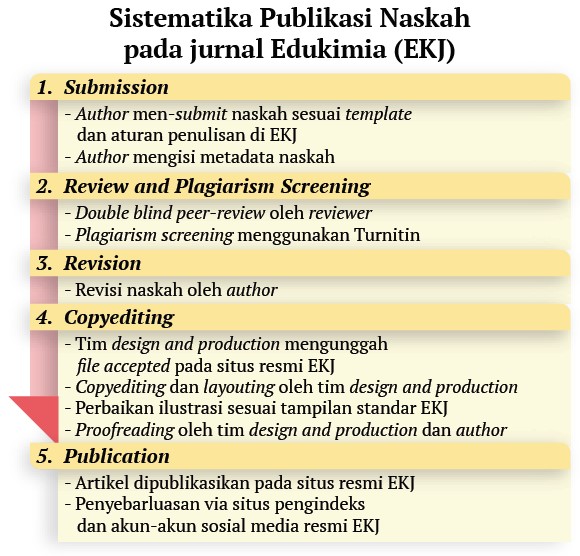
Any accepted manuscript will be reviewed by at least two reviewers, plus editorial comments. The author is required to revise the manuscript according to reviewer comments and editors. Editor team will process it for later publication. For peer review process diagrams please go to Peer Review Process page.
For submission process, please refer into this page for more information.