Artificial Intelligence (AI) Policy
- General Policy
Edukimia recognizes that artificial intelligence (AI) tools can support certain activities in manuscript preparation and editorial publishing. However, their use must comply with the principles of transparency, accountability, originality, confidentiality, and scientific integrity.
This policy establishes the requirements for AI use by authors and editorial team members and prohibits the use of AI tools by peer reviewers during the peer-review process.
AI tools must not replace human scientific judgment, research interpretation, or editorial decision-making. Authors and editors remain fully responsible for the accuracy, originality, confidentiality, and integrity of their respective work.
- AI Use by Authors
Authors may use AI-assisted tools to improve grammar, spelling, readability, language clarity, and consistency in manuscript preparation.
All AI-assisted content must be carefully reviewed, verified, and revised by the authors before submission. Authors must ensure that the use of AI does not compromise the accuracy, originality, or scientific integrity of the manuscript.
Authors must not use AI tools to fabricate or falsify research data, generate fictitious references, misrepresent research findings, or replace their own scientific analysis and interpretation.
AI tools cannot be listed as authors or co-authors because they cannot fulfill the responsibilities and accountability required for scientific authorship.
AI Use Disclosure by Authors
Authors must disclose any use of AI tools in manuscript preparation. The disclosure must identify the name of the AI tool, the purpose of its use, and the manuscript sections or activities in which AI assistance was applied.
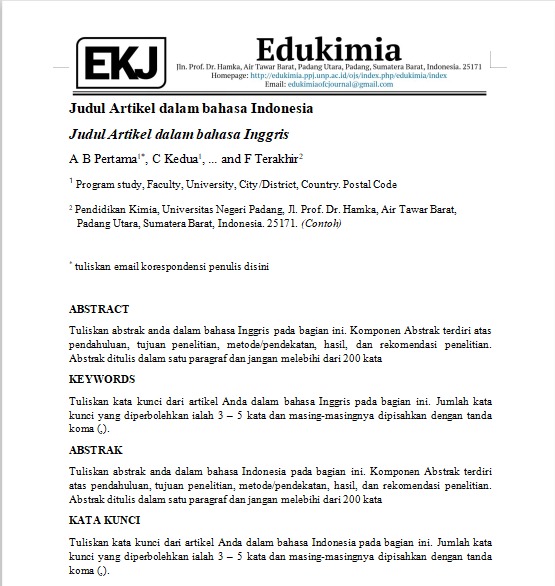
The disclosure must be included in a separate section entitled Declaration of AI Use, placed before the References section.
Example of AI use disclosure:
"The authors used ChatGPT (OpenAI) to assist with grammar correction, language refinement, and improvement of manuscript readability. All AI-assisted revisions were reviewed and verified by the authors. The authors take full responsibility for the accuracy, originality, and integrity of the manuscript."
If no AI tools were used:
"The authors declare that no artificial intelligence tools were used in the preparation of this manuscript."
- AI Use by the Editorial Team
Editorial team members may use AI-assisted tools for limited administrative or language-support activities, provided that such use does not compromise manuscript confidentiality, research integrity, or editorial independence.
Permitted activities may include improving the clarity of general editorial communications and correcting language in non-confidential editorial materials.
Editors must not upload confidential manuscripts, unpublished research data, peer-review reports, or protected editorial information to external AI applications.
AI tools must not be used to replace independent scientific evaluation or to determine manuscript acceptance, revision, or rejection.
AI Use Disclosure by Editors
Editorial team members must disclose and document any permitted use of AI tools in editorial activities, including the name of the tool, its purpose, and the activity in which it was used.
Such disclosures must be maintained in the journal's editorial records without revealing confidential manuscript information.
Editors remain fully responsible for the accuracy, confidentiality, fairness, and integrity of AI-assisted editorial activities and decisions.
- Prohibition of AI Use by Peer Reviewers
Edukimia strictly prohibits peer reviewers from using artificial intelligence tools during the peer-review process.
Reviewers must not use AI tools to:
- Analyze manuscript content, research methods, research data, or scientific findings.
- Evaluate manuscript originality, novelty, scientific quality, or methodological validity.
- Generate, draft, revise, or formulate peer-review comments, evaluations, or recommendations.
- Determine or recommend manuscript acceptance, revision, or rejection through AI-generated assessments.
- Upload, copy, paste, or enter manuscripts, manuscript excerpts, unpublished data, review reports, or other confidential review materials into AI applications.
Reviewers must conduct their evaluations independently using their own scientific expertise and professional judgment.
All manuscripts and associated review materials must be treated as confidential documents.
- Responsibility and Scientific Integrity
The use of AI does not diminish or transfer the responsibilities of authors and editors.
Authors remain fully responsible for the originality, accuracy, validity, confidentiality, and integrity of their manuscripts, including any AI-assisted content.
Editors remain responsible for maintaining manuscript confidentiality, ensuring fair and independent scientific evaluation, addressing publication ethics concerns, and making editorial decisions based on scientific merit.
AI-generated outputs must not be treated as substitutes for scientific evidence, human expertise, or independent editorial judgment.
- Non-compliance with the AI Policy
Suspected violations of this policy will be evaluated by the editorial team in accordance with Edukimia's Publication Ethics Statement and applicable publication ethics guidance.
Depending on the nature and severity of the violation, editorial actions may include requesting clarification or additional disclosure, requiring manuscript correction, rejecting a manuscript, reassigning a reviewer, or investigating concerns involving published articles.
Any action will be based on an appropriate assessment of the available evidence and the circumstances of the case.
- Relationship with Other Journal Policies
This Artificial Intelligence (AI) Policy forms part of Edukimia's publication ethics framework and should be read together with the following journal policies:
- Publication Ethics Statement
- Peer Review Process
- Author Guidelines
- Manuscript Submission Guidelines
All authors, reviewers, and editorial team members are expected to comply with the applicable provisions of these policies throughout the publication process.